
In their first structured bilateral talks in nearly five years, Prime Minister Narendra Modi and Chinese President Xi Jinping Wednesday agreed that India and China can have a 'peaceful and stable' relationship by displaying maturity and mutual respect and endorsed the pact on the resolution of the dragging eastern Ladakh border row.
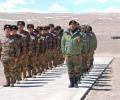
India and China failed to make any breakthrough, but agreed to maintain dialogue to arrive at a mutually acceptable resolution at the earliest.
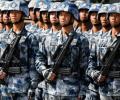
Asked about the continued tensions along the border and whether the PLA troops action was anyway related to the disagreements with the Indian government's plan to lure business out of China, Chinese Foreign Ministry spokesman Zhao Lijian said both the countries were in diplomatic contact over the face-off between their troops.
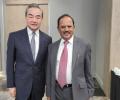
Doval is in Beijing for the 23rd round of the Special Representatives' talks being held after a gap of five years.

Defence Minister Rajnath Singh on Friday praised the Indian Army as one of the most trusted and inspiring organisations in the country, highlighting its significant role in safeguarding borders, combating terrorism and assisting civil administration in times of need.

'Given China's past behaviour and their territorial claims, should we be sceptical regarding China's willingness to adhere to these agreements fully? The answer is yes.' 'As Ronald Reagan famously said in the context of the SALT talks, 'Trust, but verify!' India should also do the same.' 'This has already begun with foot patrolling, drones, satellite imagery and so on. India's military deployment did mirror China's and will continue to do so in the future.'
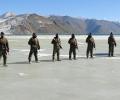
'The Arunachal border is not demarcated in that way, so there can be differing perceptions (between two sides)'
A joint statement released on Thursday said both sides exchanged views in an 'open and constructive' manner to resolve the 'relevant issues' and that it was agreed to maintain 'security and stability' on the ground in the region.

'Tensions and dialogue are likely to go hand-in-hand with China.' 'The goal should be to cultivate power so that one can negotiate from a position of strength.'
A day after the nearly 12-and-half-hour talks, the two sides, in a joint statement on Monday, reaffirmed that the resolution of the pending issues would help in the restoration of peace and tranquility along the Line of Actual Control (LAC) in the region and enable progress in bilateral relations.

Zhang made the remarks in response to India's enhancement of its military readiness through the Sela Tunnel in Arunachal Pradesh, according to a report posted on the Chinese defence ministry's website on Friday.

'India's move has grossly violated China's territorial sovereignty, seriously violated relevant agreements, protocols and important consensus reached between the two countries'

Prime Minister Modi and President Xi held the conversation on Wednesday on the sidelines of the BRICS (Brazil, Russia, India, China, South Africa) summit in Johannesburg.
India and China agreed during their military talks on Sunday to stay in close touch and work out a mutually acceptable solution to the "remaining issues" in eastern Ladakh at the earliest, but there was no indication of clear forward movement in ending their three-year-long border standoff.

Defence Minister Rajnath Singh on Wednesday asked the Army to maintain strong vigil along the Line of Actual Control (LAC) with China as the situation in the northern sector remained "tense" in view of deployment of PLA troops.
Some may see China's decision to antagonise India as strategically unwise. But China believes its prestige demands standing up to India, whatever the cost.

Chinese President Xi Jinping, who made a rare visit this week to the restive Xinjiang region which borders Ladakh, met the troops and officers stationed there and praised their "outstanding contributions" to the border defence and stabilisation of the volatile province.
It also noted that under the leadership of Prime Minister Narendra Modi, India is more likely than in the past to respond with military force to Pakistani provocations.

The Wednesday talks took place amid a war of words between the two sides on perception of the LAC, the de-facto Sino-India border spanning a length of nearly 3,500 km.
A day after the nearly 13-hour meeting, the two sides in a joint statement on Saturday reaffirmed that such a resolution would help restore peace and tranquillity along the Line of Actual Control (LAC) in eastern Ladakh and facilitate progress in bilateral relations.
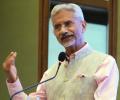
"It finally takes two hands to clap and China too must have the belief in a workable relationship," he said when asked whether the two Asian giants can have a working relationship.

In an address at a leading think-tank in Paris, Shringla mentioned two recent terrorist incidents in France, one of which he said had its origins in Pakistan, noting that the civilised world needs to act with firmness to address the threat of terrorism.

India and China on Friday held 'in-depth' discussions on addressing the remaining issues along the Line of Actual Control (LAC) in eastern Ladakh, holding that disengagement in the North and South banks of Pangong lake provided a good basis to work towards their early resolution.
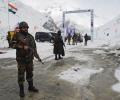
With Beijing remaining intransigent on the withdrawal of additional troops deployed by the People's Liberation Army (PLA) since the deadly border clash in 2020 in eastern Ladakh, India's bilateral ties with China remained frozen in 2023 with no forward movement on the horizon despite several rounds of diplomatic and military talks.

India and China will complete the disengagement process in the Gogra-Hotsprings area in eastern Ladakh by September 12, the External Affairs Ministry said on Friday.
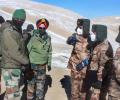
India and China on Tuesday agreed to hold the next round of the Senior Commanders meeting at an early date to achieve complete disengagement from all friction points in eastern Ladakh to create conditions for the restoration of normalcy in bilateral ties.
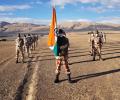
India and China on Friday agreed to hold the next round of military talks at an early date to achieve the objective of complete disengagement in remaining friction points in eastern Ladakh amid fresh sparring between the two sides on the prolonged Line of Actual Control (LAC) standoff.
The Chinese government had "planned" the Galwan incident in June even as Beijing ramped up its multiyear coercion campaign against its neighbours, provoking military or paramilitary standoffs with countries from Japan to India, the United States top panel said in its report released on Wednesday.

rediffGURU Ramalingam Kalirajan answers your personal finance queries.
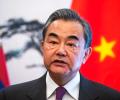
Addressing a symposium on the international situation and China's foreign relations in 2022, Wang said both countries have maintained communication through diplomatic and military-to-military channels.
Indian Army Chief General M M Naravane had said on Wednesday that India was hopeful of resolving issues related to disengagement at Patrolling Point 15 (Hot Springs) in eastern Ladakh in the 14th round of talks.
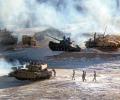
'India cannot allow Beijing's policy of stabilising and destabilising the border at will to perpetuate its own ends.' A riveting excerpt from Manish Tiwari's 10 Flashpoints; 20 Years National Security Situations That Impacted India.
"Against such background, the words and deeds of relevant important military and government officials and military deployments should be conducive to deescalating and cooling down the situation, and to enhancing mutual trust, rather than the opposite", the spokesman said.
"The meeting thus did not result in resolution of the remaining areas," the Army said in a statement.

After India firmly told China that its violation of the border pacts has "eroded" the entire basis of bilateral ties, China's defence ministry on Friday said the situation at the border is "generally stable" and both sides should put the boundary issue in an "appropriate position" and promote its transition to "normalised management".

Amid demands for snapping trade ties with China for its transgressions on the border, former Niti Aayog vice chairman Arvind Panagariya has opined that cutting trade with Beijing at this juncture would amount to sacrificing India's potential economic growth. Instead, Panagariya suggested that India should try to enter into free trade agreements (FTA) with countries such as the UK and the European Union to expand its trade. "Engaging China in a trade war at this juncture will mean sacrificing a considerable part of our potential growth... purely on economic grounds, it will be unwise to take any action in response to it (transgressions on the border)," the eminent economist told PTI.
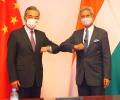
Jaishankar said full restoration and maintenance of peace and tranquillity in border areas was essential for the development of the bilateral ties.
Foreign ministry spokesman Zhao Lijian, during a media briefing in Beijing, said that China's position on the border related issues is clear and consistent. "We have been following the important consensus reached by the two leaders and strictly observing the agreements between the two countries," he said, apparently referring to the directions of Chinese President Xi Jinping and Prime Minister Narendra Modi after their two informal summits, asking the militaries of the two countries to take more confidence building measures to maintain peace and tranquillity along the borders.
Two days after the India-China military talks, the joint statement, issued in New Delhi by the Indian Army said both sides had a 'candid and in-depth exchange' relating to disengagement along the Line of Actual Control (LAC) in the Western Sector of India-China border areas.
The Indian side forcefully pressed for early resolution of the standoff and particularly insisted on expeditious disengagement in Hot Springs and Gogra, a source said.
